
AI Did Not Make Learning Less Necessary
AI amplifies prior knowledge

There is a mistake I keep seeing in discussions about AI and higher education. It appears in two different reductions of the same problem. In universities, AI conversations often collapse into discussions about fraud and cheating. That discussion matters. Students can use AI to produce work that appears to be their own. But in public speeches about AI, especially commencement addresses, another reduction appears: executives tell graduates that the world has changed so radically that what they learned “may already be obsolete”.
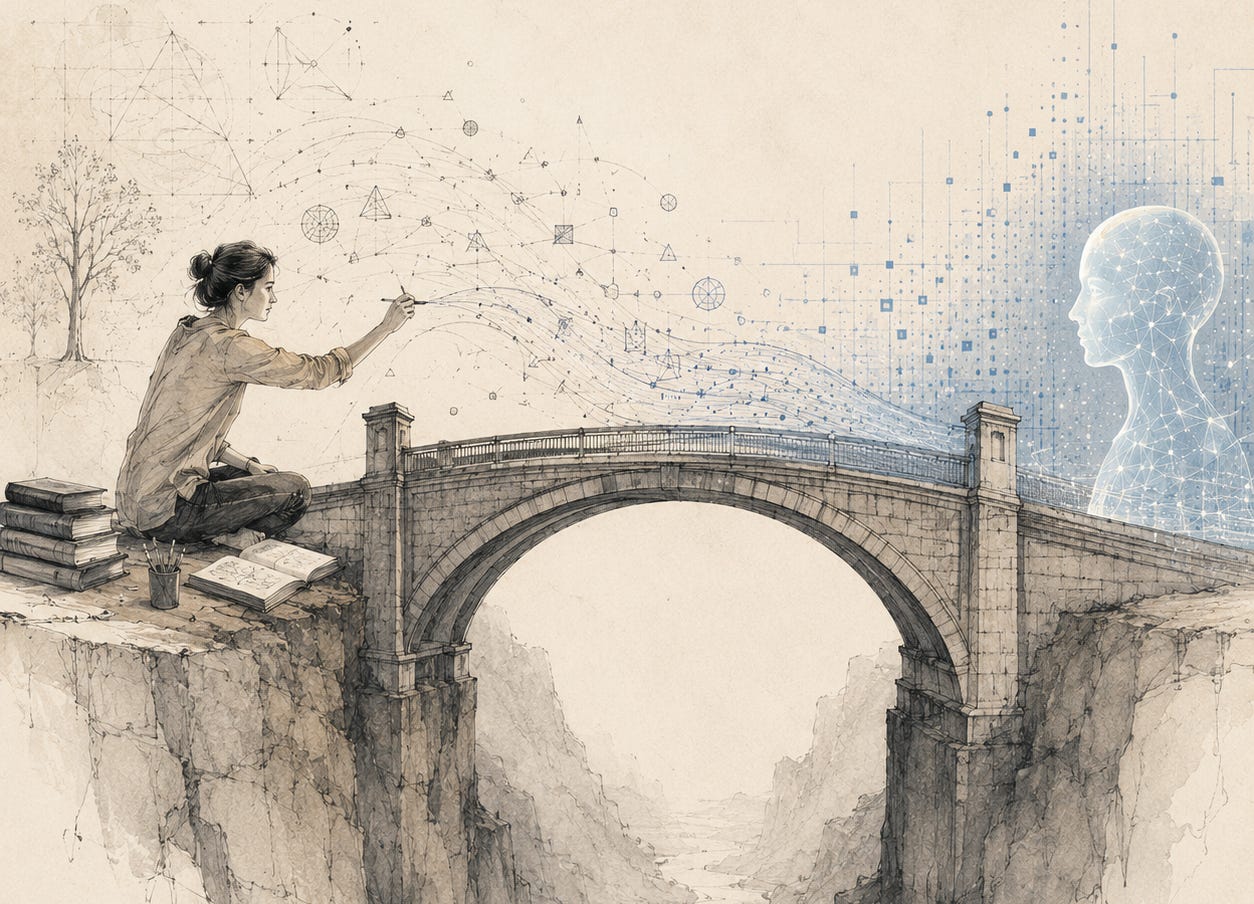
AI did not make learning less necessary. It made the construction of knowledge even more decisive. The people who can use AI well are not those who know less. They are those who already have enough knowledge, vocabulary, criteria, and experience to ask the right questions, reject weak answers, detect errors, and integrate what the machine returns into a meaningful process.
AI amplifies prior knowledge. It does not replace the need for it.
The poverty of the cheating debate
In many discussions about AI in higher education, everything quickly moves toward plagiarism and fraud. Some of us feel a bit tired of this discourse, because we want to spend more time discussing how we can improve the use of AI by students.
I say this, not because assessment should be ignored, on the contrary. If a course depends on work done at home, group projects, reports, or practical assignments, it needs at least one supervised anchor. Not a final exam worth 100%. That would be a poor return to old education models. But a written test, in class, supervised, worth 30% or 40% of the grade, changes the whole problem. This is even stronger when each assessment component has a minimum grade. A student may do well in the project. But if they cannot reach the minimum threshold in the supervised component, they do not pass the course.
This matters because the goal is not to detect every possible misuse of AI. That is impossible. It was impossible before AI, too. A student could always ask someone else to write a paper, pay for help, copy from online sources, recycle previous work, or rely on extensive tutoring. AI makes this easier and faster. It lowers the friction. But it does not create the basic problem.
A take-home assignment was never a secure assessment environment. That is why recent debates around Princeton and Stanford are so revealing. In Princeton, according to The Atlantic, the university has begun to change a 133-year-old Honor Code tradition that allowed students to take exams without professors in the room. Students signed a pledge and were expected to report peers who cheated. In 2026, Princeton faculty voted to begin proctoring in-person exams again. At Stanford, a New York Times essay described a similar return to proctored exams and handwritten blue books.
Students are human beings. They respond to incentives. They optimise. So the question is not whether AI cheating can be eliminated. It cannot. The question is whether a student can pass without ever showing, under accountable conditions, that they understand what the course required them to learn.
Fluency is not understanding
The deeper problem is not fraud. It is the illusion of competence. AI produces fluent language. It gives answers that are structured, confident, and often useful. It can write text, generate code, produce plausible explanations, and more. That fluency is powerful, but also dangerous.
A student who does not understand the subject may still receive an answer that looks competent. The text looks respectable, feels academic, and the tone is assured. The student believes it is good. But without knowledge, the student cannot know what is missing.
They cannot tell whether the answer is true, outdated, or even irrelevant. They cannot evaluate the sources. They cannot see where a concept has been flattened. They cannot notice that a technical solution creates problems later in the pipeline. They cannot distinguish an elegant answer from a correct one.
This is where the rhetoric of “what you learned is already obsolete” becomes dangerous. If students believe that foundations matter less because AI can generate outputs, they become more dependent on outputs that they cannot judge. The risk is not only that they will know less. It is that they will feel as if they know more, without really knowing.
Prior knowledge is the real amplifier
The strongest users of AI are not empty users. They bring a world to the exchange. They know the field, the vocabulary. More important, they know what matters and so what to ask. They can easily tell when the machine is operating in generic mode. And so, they know how to push, when to stop, what needs to be verified, and what should be ignored.
This is why AI does not democratise competence as easily as some people imagine. Access to the tool is not the same as access to the knowledge that makes the tool powerful. A good user does not merely prompt. A good user frames.
This connects with a previous essay I wrote, Generating Is Not Creativity, I was reflecting on Silvia Rondini’s study on visual creativity, where visual artists produced the strongest results, followed by non-artists and human-guided AI, while self-guided AI came last. What mattered was not simply whether AI could generate images. What mattered was whether the system had a frame, a direction, a semantic anchor.
The model did not discover the frame. It needed the frame to be given. That is not a small detail. It is the centre of the problem.
AI is powerful once the relevant space has been shaped. It can expand, recombine, translate, stylise, compare, accelerate. But deciding what matters, what counts as relevant, what must be preserved, what can be abandoned, and what gives the result meaning remains a human task.
Vygotsky and the need for world
This is where Vygotsky becomes useful. He argued against the common idea that children are more creative than adults. Children may seem more imaginative because they combine freely. They play, deform, transform, and mix things without much inhibition. But creativity does not come from variation alone. Creativity needs material. It needs experience. It needs world.
For Vygotsky, imagination draws from lived experience. The richer the experience, the richer the material available for recombination. A child can generate many possibilities, but often lacks the density of experience that allows those possibilities to acquire deeper meaning.
This matters for AI. AI is extraordinary at variation. It can generate combinations, styles, images, outlines, arguments, analogies, and alternatives. But generation is not yet creativity. Without world, intention, memory, commitment, and responsibility, variation remains unstable. This is why the slogan from my talk at the University of Algarve still matters to me:
Creativity is not generating. Creativity is the stabilization of meaning within variation.
Consequently, AI can expand the possible. Dialogue will reorganize the thinkable. But only human commitment will turn variation into form.
In the Nature paper on Co-Scientist, AI is not presented as a magic generator of final truth. It is part of a structured process: hypothesis generation, reflection, ranking, refinement, review, and validation. The human scientist remains in the loop. The human defines goals, constraints, desirable attributes, feedback, candidate selection, and validation priorities.
The value is not in producing many outputs. The value is in improving them through structured cycles of judgment.
Education cannot stop at prompting
Teaching students to use AI cannot mean teaching them how to prompt. Students need disciplinary foundations. They need concepts, methods, histories, criteria, and verification practices. They need to know how knowledge is built in a field. They need to know what counts as evidence, what counts as a good explanation, what counts as a weak claim, and what counts as an error.
They also need to learn how to disclose AI use, how to attribute sources, how to verify claims, how to keep process evidence, and how to remain responsible for the final form.
In our national work on AI in higher education in Portugal, we have insisted on governance, literacy, institutional responsibility, and critical use. This cannot be reduced to technical adoption.
AI literacy without disciplinary knowledge is thin. It teaches students how to operate a machine without knowing how to judge what the machine gives back. That is not empowerment. It is dependency with a user interface.
This brings us back to assessment. The function of a supervised test is not to punish AI. It is to distinguish assisted production from accountable understanding.
If a student uses AI to develop a project, that can be legitimate. But the student must be able to explain the choices made, defend the project orally, connect it to readings, and demonstrate understanding without support.
A supervised component with a minimum grade does not solve every problem. It does not measure everything we value. It does not replace projects, portfolios, writing, discussion, or experimentation. But it prevents a polished product from carrying the whole burden of certification.
Knowledge after AI
The wrong lesson from AI is that students need to know less because machines can produce more. They need to know more.
Or perhaps more precisely: they need stronger foundations, because the surface of competence has become easier to simulate.
This does not mean filling students with static content. It means giving them enough world to think with. Enough disciplinary ground to ask good questions. Enough criteria to resist fluent nonsense. Enough experience to recognize when something matters.
Students without foundations may become curators of generated options, capable only of adding more of the same. Students with foundations can become stronger thinkers, able to make a difference.
Process disclosure
This essay was developed over more than a month through several iterations of dialogue with AI. The process began with concerns about AI cheating, assessment design, and supervised tests. It then moved through Princeton’s Honor Code, take-home exams, student reactions to pro-AI graduation speeches, the role of foundational knowledge, and finally Vygotsky’s argument that creativity depends on lived experience.
AI did not accelerate the process in any simple sense. It gave form to provisional arguments, returned alternatives, clarified tensions, and helped me test directions. But the movement of the essay was human-led. I brought the doubts, the corrections, the new examples, the changes of direction, and the final argument.
AI was part of the process. Authorship and responsibility are mine.
AI gives people more material to work with, yet it doesn't remove the need to understand that material.
The same problem is found in professional work. A ready to use, generated answer is not always a complete and fully functional answer. The person receiving it still needs enough vocabulary, context, and judgment to know whether it will move the work forward.