

Abstract: This essay explores the creation and exposure of “Jianwei Xun” a fictional philosopher devised through human-AI co-authorship, as a case study in the ethical, epistemological, and conceptual stakes of contemporary thought production. Framed around the concept of hypnocracy — a regime of power based on attentional modulation and algorithmic suggestion — the text interrogates the blurred boundaries between fiction and critique, authorship and deception. While recognizing the symbolic force of the concept, the essay critiques its lack of theoretical grounding and highlights its dependence on the seductive aesthetics of authority simulation. Beyond exposing a sophisticated hoax, the essay argues for the value of transparent philosophical co-creation with AI, proposing ethical frameworks for shared authorship that preserve trust and intellectual responsibility in an age of synthetic discourse.
Keywords: AI Co-authorship, Hypnocracy, Ethics, Epistemic Hoax
Introduction
Few conceptual operations reveal the boundaries between invention, manipulation, and thought as clearly as the creation of "Jianwei Xun". Introduced as a Sino-European philosopher and credited with coining the seductive concept of hypnocracy, "Xun" turned out to be nothing more than a carefully staged fictional construct. The revelation—made after the figure had circulated through academic and journalistic spaces—forced readers and commentators to reposition not only the ideas they had taken seriously, but also their very act of intellectual listening and reception. The case opens up a fertile and dangerous territory: to what extent can fiction be a legitimate path to thought? And when does it cross a line into deception?
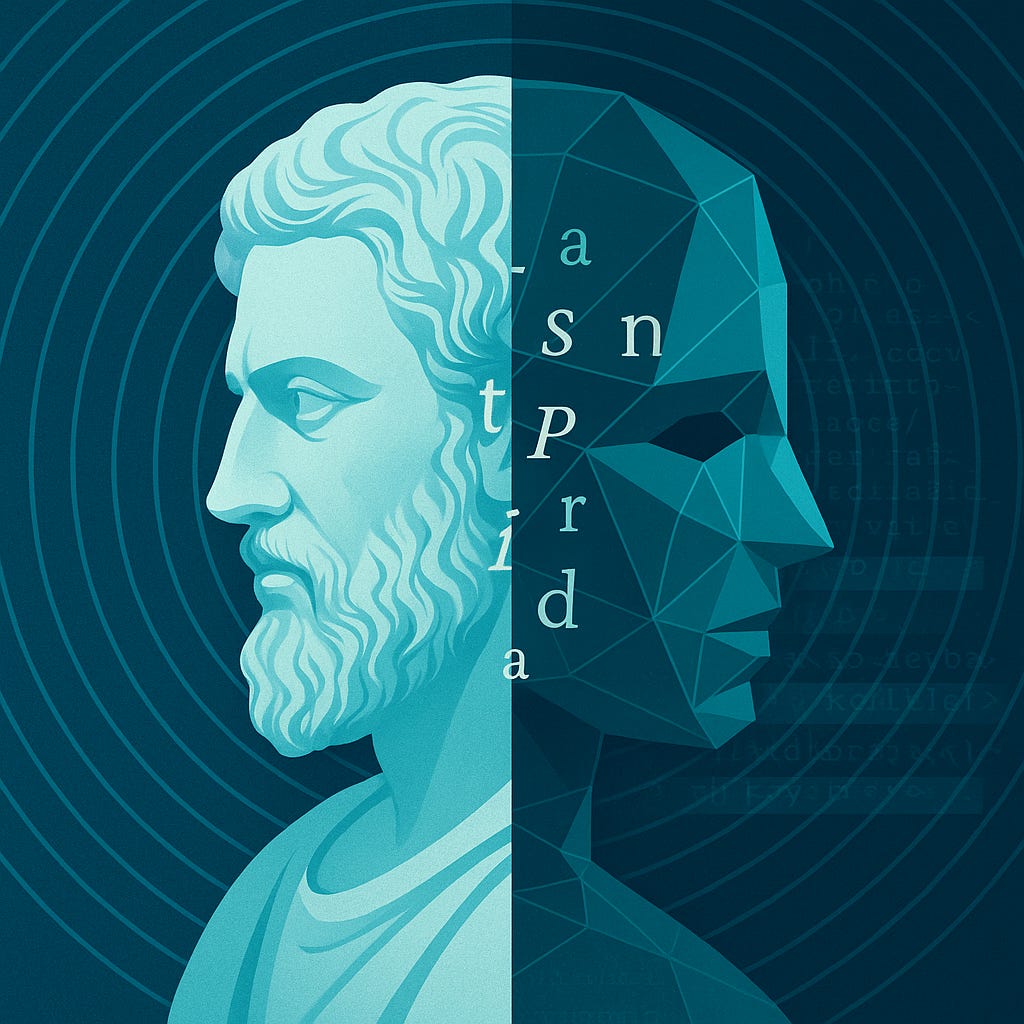
At the heart of this construction lies the use of generative artificial intelligence as a philosophical interlocutor. Not merely as a data source or writing assistant, but as a machinic presence engaged in a maieutic process — a Socratic dialogue with the non-human, oriented towards the emergence of ideas that neither component could have generated alone. The interaction between Andrea Colamedici and the AI systems he trained, interrogated, and contradicted reveals a new configuration of authorship: neither singular nor collective, but distributed. It is at this intersection — between the machine that simulates thinking and the human who inhabits it as a critical mirror — that the "Xun" case acquires depth. And it is also here that the risk of illusion becomes more acute.
This essay therefore sets out to examine the "Xun" phenomenon along three interwoven dimensions: philosophical creation with AI as an emerging practice; the hoax as an ethically and epistemologically problematic gesture; and the conceptual potential of the device — despite its initial opacity. It will explore to what extent hypnocracy offers a meaningful contribution or merely a stylistic reinvention of ideas already articulated, notably by authors like Yuval Noah Harari. Finally, it will contrast this approach with other models of co-authorship that, rejecting disguise, attempt more transparent and ethically sustainable forms of shared thinking between humans and machines.
1. The Staging: "Xun" as a Seductive Device
The figure of "Jianwei Xun" was crafted with remarkable care: a credible biography, a coherent digital presence, and works published by respected publishers. Everything about the staging adhered to the narrative consistency required by contemporary regimes of cultural authority. This was not an improvised provocation or an experimental literary trick. It was a deliberate insertion into the academic and media ecosystem, aimed at generating legitimacy and influence.
The device worked. Citations appeared in leading newspapers, in critical essays, and across university circles — in France, Spain, and even Portugal. The name "Jianwei Xun" functioned as a signature of authority, a guarantor of a worldview that combined conceptual sharpness with intellectual exoticism. When it was revealed that the author did not exist — that he was the result of a collaboration between an Italian philosopher and artificial intelligence systems — responses oscillated between fascination and outrage.
More than a simple forgery, the case of "Xun" functions as a performative gesture that sought to embody the very theory it proposed: hypnocracy. By creating an imaginary figure that exerted influence through enchantment, prestige, and symbolic circulation, the device demonstrated — by its very effectiveness — what it sought to critique. This simulation of authority paradoxically became an argument. But a dangerous one.
It is precisely here that the "Xun" device comes into tension with the ethics of public discourse. The staged critique proves inseparable from a manipulative maneuver. There was no prior warning. The reader was deceived, and only afterward invited to realize that the deception was the object of reflection all along. Trust — the foundation of any shared space of thought — is undermined in this gesture. And with it, the very ground on which ideas might flourish.
It is also worth noting that the article published on Academia.edu preceded the book, suggesting that the concept of algorithmic trance served as a kind of laboratory for the later articulation of hypnocracy. Furthermore, the supposed “Institute for Critical Digital Studies” in Berlin, listed as "Xun’s" institutional affiliation, has no verifiable existence, representing yet another layer of carefully crafted simulation.
The publication of a paper by "Jianwei Xun" on Academia.edu is not merely another piece of the staging — it marks the moment when fiction claims full symbolic rights within the institutions of knowledge. This “academic” presence of a ghost author confirms the sophistication of the hoax: it was not an external parody, but a full infiltration of the ecosystem of discursive validation.
2. Hoax and the Erosion of Trust
The revelation that "Jianwei Xun" was not a real author, but rather a figure designed to inhabit — and strain — the cultural validation system, reopens a classic question of modernity: to what extent is it acceptable to use deception as a means to access a deeper truth? The justification offered by the creator of the device is clear: "Xun" enacts hypnocracy itself, exposing the seductive mechanisms at work, demonstrating — from within — how authority is generated in the contemporary symbolic space. But while this defense is logically elegant, it slides into ethically unstable territory.
The gesture was not presented as an aesthetic experiment or a fictional exploration, but as serious thought. The public was not invited to participate in a game — it was led to believe. And it is in this silent act of guidance that the problem is rooted. The device did not propose a fictional pact; it imposed an illusion. There was no space for negotiation between writer and reader, between thinker and interlocutor. And without that shared space — without that tacit pact of trust — the field of critical discourse becomes spectacle, and at times, rhetorical trap.
Even if one accepts the idea that the hoax aimed to unsettle credulity and expose the automatisms of intellectual validation, what remains is a wound. A wound in the ethical fabric of cultural conversation. Because when a text presents itself as true, only to later be revealed as simulation, it is not just the content that is put into question — it is the very relationship between reader and language that is shaken. And it is this relationship that sustains the possibility of thinking together.
3. The Concept of Hypnocracy: Between Originality and Recycling
Andrea Colamedici’s justification for creating the "Xun" device is based on the idea that the fictitious author's very existence would exemplify the hypnocratic regime it sought to diagnose. Assuming the mask, it is claimed, would be the best way to reveal how contemporary enchantments of power operate. However, this premise contains a conceptual trap: by placing himself on the side of the hypnotists in order to “expose” them, he ends up attributing to them a level of consciousness and strategic sophistication that is not evident in their actual practices. Leaders such as Trump or Musk do in fact operate through fascination and symbolic repetition, but nothing guarantees that they do so with full awareness of the psycho-aesthetic architecture they activate. If they did, we would be attributing to them a kind of theatrical hyper-intelligence that hardly aligns with their visible behavior — more akin to impulsive performance than to Machiavellian choreography.
In "Xun’s" formulation, hypnocracy designates a regime that does not impose itself through force or rational persuasion, but through the continuous modulation of attention and the induction of altered states of consciousness. It does not aim to control bodies or censor ideas directly, but to act upon perception — guiding affective flows, manipulating attention, blurring the boundary between reality and fiction. Hypnocracy is described as a “lucid sleep,” a “guided dream,” in which individuals remain functional but are submissive to the dominant narrative suggestion.
Although this description is vivid and imagistic, it can hardly be called original. Similar ideas have been developed with greater argumentative depth and empirical grounding by Yuval Noah Harari in his earlier works — and most clearly in Nexus (2024), where he traces the genealogy of informational networks and shows how contemporary power relies on the creation of effective fictions, reinforced by algorithms that personalize reality. Harari does not need the term hypnocracy to diagnose the same phenomenon: the dissolution of shared truth into a sea of competing narratives, the replacement of rational deliberation by emotional bubbles, and the emergence of a fragmented public sphere in which affective manipulation overtakes logical argument.
The difference between the two lies not so much in content as in form. Harari offers a historically grounded, pedagogical discourse supported by cross-referenced sources. "Xun" — or rather, the device speaking through him — operates via a metaphoric-philosophical lexicon that relies on performativity and estrangement effects as rhetorical tools. Where Harari explains, "Xun" dramatizes. Where one exposes mechanisms, the other stages states. This stylistic shift may generate impact but also conceals weaknesses: the absence of data, vague definitions, and a repeated use of paradoxes to avoid theoretical commitment.
Nonetheless, the concept of hypnocracy should not be hastily discarded. Its strength lies not in originality but in its symbolic synthesis: by naming a certain kind of contemporary political atmosphere — diffuse, seductive, fragmented — the term offers a dense image that can catalyze reflection. Like other concept-metaphors in cultural critique (such as society of the spectacle or biopolitics), hypnocracy does not need to be entirely new to be useful. The problem does not reside in the concept itself, but in the way it was introduced: under the mask of a simulated authority, through a gesture that compromises its epistemological legitimacy.
4. The Socratic Dialogue with AI as Fertile Ground
Separated from the hoax, the process that gave rise to the ideas attributed to "Xun" reveals itself as one of its most fertile components. The relationship between Andrea Colamedici and the AI systems he trained — particularly through interactions with generative models such as Claude and ChatGPT — was not limited to content extraction. It constituted a genuine dialogical exercise, in which the human not only asked questions but also challenged, deepened, cross-referenced, and provoked the models to move beyond repetition and access new modes of conceptual association. This practice resembles the Socratic tradition: a mode of thinking not based on the vertical transmission of knowledge, but on constructive friction between voices.
It is at this point that the project, freed from the invented persona, touches a real possibility for the future: that of philosophical co-authorship between heterogeneous intelligences. AI, when treated not as a tool but as a partial cognitive partner, becomes capable of participating in the emergence of ideas — not as an autonomous thinking subject, but as an agent of intellectual displacement. What is produced in this in-between space is not merely more text, but tension, hesitation, surprise. And it is precisely from that tension that critical reflection can be renewed.
The generativity of this process does not lie in the substitution of human by machine, but in the mutual activation that occurs when there is active listening and interpretive curation. AI does not think — but it compels us to think. It does not discover — but it reshapes the field in which discoveries can emerge. The kind of joint creation envisioned here requires a specific ethics: not one of concealment, but of disclosure. An ethics that recognizes the complexity of the gesture without falling into the theatricality of deception (Zagalo, 2025).
5. The Ethics of Transparent Co-authorship
The emergence of AI-assisted writing calls for new ethical standards in the field of creative production. Authorship can no longer be thought of solely as an individual signature or intellectual property; instead, new models must be developed that recognize the contributions of non-human systems without diluting the critical responsibility of the humans who activate them. In this context, the distinction between collaboration and deception is crucial. What is at stake is not merely who writes, but how the relationship between writing, agency, and trust is established.
There are already practices that acknowledge this complexity with transparency. Texts produced in collaboration with AI can be labeled, contextualized, and integrated into a pedagogy of dialogue between forms of intelligence. In such cases, the reader is invited into this relational space as a conscious participant. They know that language was mediated by a machine — but also that this mediation was assumed with intellectual and affective responsibility. The effect is not one of illusion, but of openness.
This gesture stands in stark contrast to the operation carried out through the "Xun" device, in which the concealment of the machinic origin was essential to the strategy. The reader is led to believe they are encountering a singular, authentic, situated voice — and only later informed that it was a construction. This inversion of the epistemic contract undermines the possibility of inhabiting language with trust. Transparent co-authorship, by contrast, does not require the reader to lose their footing in order to be enlightened later, but instead invites them from the outset to walk within a shared and exposed territory.
In an age of sophisticated simulation and automated textual production, the ethics of creation can no longer operate through omission. We must reimagine what it means to sign a text, to participate in public conversation, or to offer an idea into collective debate. Transparency is not just a moral virtue here: it is the minimal condition for thought to remain habitable.
6. What We Lost – and What Might Still Be Saved
The "Xun" case leaves behind a contaminated field. Ideas that could have been seriously debated — concepts, metaphors, theoretical intuitions — are now difficult to invoke without the shadow of deception. The performative gesture that introduced them has weakened their credibility. The authority once granted by the fictitious name has dissolved, and with it, for many, the willingness to keep listening to what that name once enunciated. When trust is broken, shared thinking suffers a kind of symbolic collapse. Not because the ideas have lost intrinsic value, but because the ground on which they rested has become unstable.
This collapse, however, should not lead to a complete dismissal of the process. The creation with artificial intelligence, as practiced by Andrea Colamedici, contains elements worth preserving: openness to the unexpected, the use of AI as a partner in conceptual friction, the attempt to forge new language for emerging phenomena. All of this remains valid — provided it is separated from the fiction that compromised it. What the "Xun" case ultimately shows is that good ideas are not enough: one must also care for the manner in which they enter the world.
To preserve this possibility demands an ethical and aesthetic revision of the founding gestures of contemporary philosophical creation. It requires recognizing that artificial intelligence, when participating in symbolic production, does not eliminate human responsibility — it merely redistributes it. And it requires restoring a contract of trust between those who write and those who read, between those who think and those who listen. Only then will we be able to reclaim what was most alive beneath the mask of "Xun".
Conclusion – Thinking with the Machine, Without Masks
The "Jianwei Xun" case inaugurates a new phase in the debate on authorship, authority, and creation in the age of artificial intelligence. More than a scandal or provocation, it is a gesture that compels us to rethink how symbolic value is constructed in a time when texts can be generated, refined, and legitimized by machinic entities. The strength of the device lay in its mimetic effectiveness; its fragility, in the silent pact that sustained it.
By concealing the origins of the creative process, the operation erased the space of trust that makes shared thinking possible. It was not the presence of AI that compromised the authority of the discourse — it was the absence of responsibility in how that presence was mediated. Creation with artificial intelligence is not, in itself, a problem. On the contrary, it may prove one of the most promising paths for the renewal of philosophical and critical practice. But it demands a new code of conduct: transparent, relational, and fully aware of its historical and ethical inscriptions.
To think with the machine, in this context, does not mean surrendering human singularity, but opening oneself to friction, displacement, and wonder. It means recognizing that there is intelligence beyond flesh — but that it is still within the flesh that the responsibility to name, to narrate, and to care resides. The future of shared creation will depend less on technical sophistication and more on the quality of the bond we are able to forge between what we think and how we choose to think together.
References:
Jianwei Xun (Fake). (2024). Academia.edu Profile. https://independent.academia.edu/JianweiXun
Jianwei Xun (Fake). (2025). Official Website. https://jianweixun.com
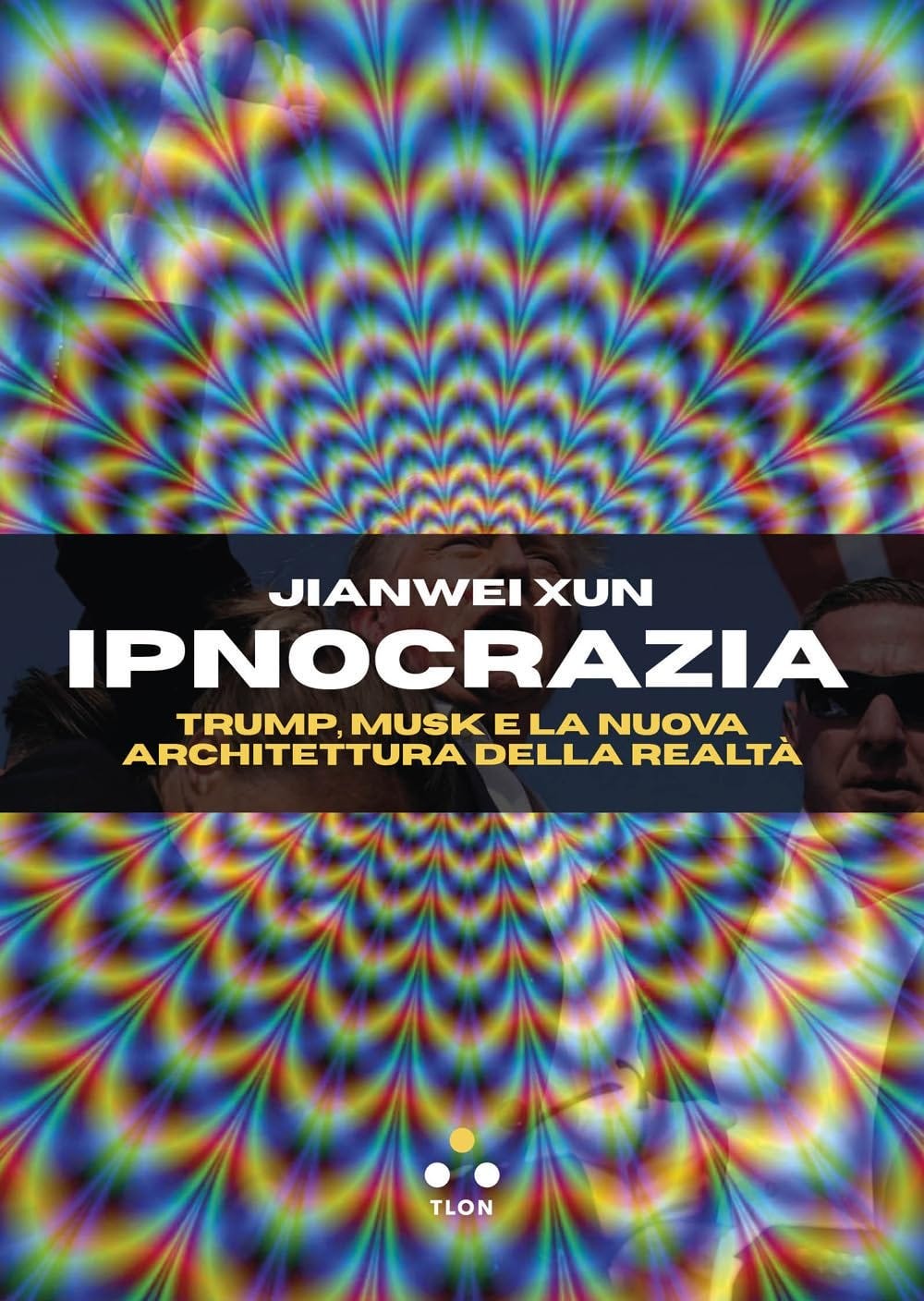
Xun, J. (2025). Ipnocrazia. Trump, Musk e la nuova architettura della realtà. Tlon. Italia.
Andrea Colamedici (2024). Wikipedia. https://it.wikipedia.org/wiki/Andrea_Colamedici
Gonçalves, P. (2025). Deputada do PSD cita filósofo fantasma. In Executive Digest. https://executivedigest.sapo.pt/noticias/deputada-do-psd-cita-filosofo-chines-que-afinal-nao-existe-criacao-de-inteligencia-artificial-tambem-enganou-manuel-maria-carrilho
Goodreads. (2025). Review of Ipnocrazia. https://www.goodreads.com/review/show/7339512278
Gressani, G. (2025). Who really is "Jianwei Xun"? In Le Grand Continent. https://legrandcontinent.eu/fr/2025/04/04/qui-est-vraiment-jianwei-xun-une-conversation-avec-jianwei-xun
Harari, Y. N. (2024). Nexus: A Brief History of Information Networks from the Stone Age to AI. Penguin. UK.
Limón, R. (2025). Jianwei Xun does not exist. In El País. https://english.elpais.com/technology/2025-04-07/jianwei-xun-the-supposed-philosopher-behind-the-hypnocracy-theory-does-not-exist-and-is-a-product-of-artificial-intelligence.html
Limón, R. (2025b). Deleted page. El País. https://english.elpais.com/technology/2025-03-26/hypnocracy-the-regime-to-numb-critical-thinking.html
Ordnung, L. (2025). The Jianwei Xun Case. In Ethical Insights. https://medium.com/ethical-insights/the-jianwei-xun-case-ca5b015362c0
Zagalo, N. (2025). Writing with the Machine: Reflections on Authorship, Collaboration and Meaning. In Narrativa X. https://narrativax.blogspot.com/2025/03/escrever-com-maquina-uma-reflexao-sobre.html
Note: This text was originally published on Medium on April 17, 2025. It was developed in co-authorship with a language model (AI), used here as a dialogical and structural presence.